ArchiveFM

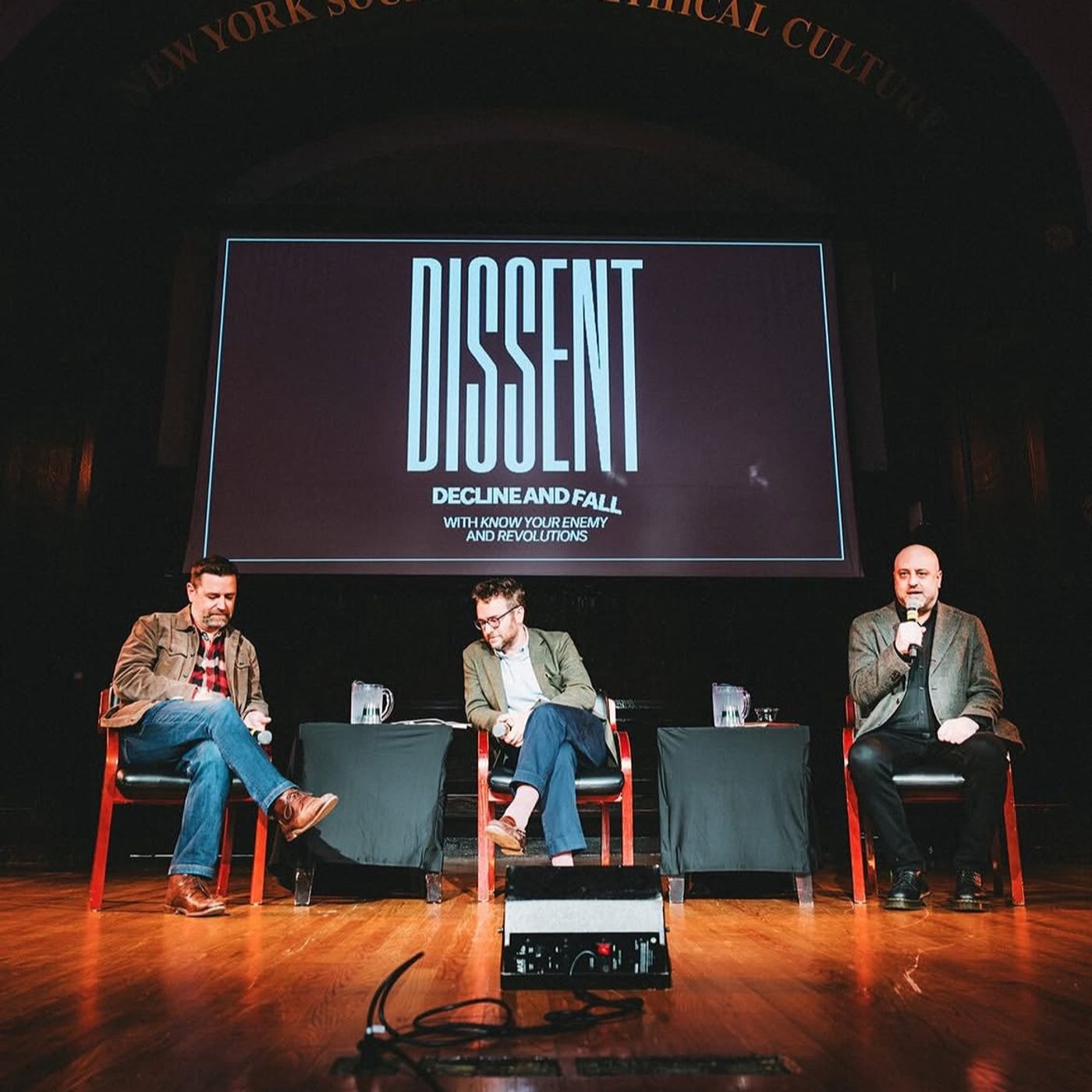
For KYE's first ever live show, Matt and Sam were joined by Mike Duncan, host of the Revolutions and History of Rome podcasts, to discuss how the right (and left) talk about American decline.
Duration
3m
Broadcast on
01 Jun 2026
Audio Format
other

Listen to the rest of this premium episode by subscribing at patreon.com/knowyourenemy.

Last month, on May 14th, we were joined by nearly 800 listeners in New York City for the first ever Know Your Enemy live show, "Decline and Fall." The event was a fundraiser for Dissent, so we called in the big guns, our great friend Mike Duncan, to join us on stage. Many KYE listeners will be familiar with Mike, the brilliant and prolific host of the Revolutions and, especially relevant for the purposes of this conversation, History of Rome podcasts. We discuss how the right talks about decline, their hilariously ignorant invocations of Rome, our very symptomatic obsession with political decline and dissolution, the power of nostalgia and declension narrative—and then answer audience questions!

Thank you again to everyone who joined us in person, to Mike Duncan, to Patrick Iber and Rosalie Ryan and everyone at Dissent, to our intrepid producer Jesse Brenneman (who was able to fly in from Montana to join us), to listeners near and far who so generously continue to support Know Your Enemy!

Donate to Dissent here.

Photo credit: Jack Califano

Sources:

For quotes from conservatives about Rome's decline: Reagan, Nixon, Buchanan, Vance

Mike Duncan, The Storm Before the Storm: The Beginning of the End of the Roman Republic (2017)

James J. Walsh, The Thirteenth, Greatest of Centuries (1907)

Michael Oakeshott, Rationalism in Politics and Other Essays (1962)

Kate Wagner, "Fear of a Breakdown," Late Review, May 11, 2026.

D.W. Winnicott, "Fear of a Breakdown," Intl. Review of Psychoanalysis, (1974)

Anybody know the British psychoanalyst Donald Winnacott, D.W. Winnacott? He has this incredible paper called "Fear of a Breakdown" which describes the strange temporality of mental disintegration. He writes, "The fear of breakdown is often the fear of a breakdown that has already been experienced." So think about that. Winnacott writes, "There are moments when a patient needs to be told that the breakdown, a fear of which destroys his or her life, has already been. It is a fact that is carried round hidden away in the unconscious." So what Winnacott is speculating here is that the thing we fear most, the psychic disaster that would be our undoing, that would render us incapable of love, work, or care, belongs to the past. It has already happened to us. We are living in its wreckage. We just can't see it. And so fearful are we of its destructive consequences. We displace the cataclysm into the near future. The disaster is perennially about to happen. Rendering us all the more incapable of addressing its causes and consequences of putting ourselves back together. Our ego experiences this displacement as a protective self-curer, but it is actually a form of self-imprisoning stasis and self-sabotage. Friend of the show, architecture critic Kate Wagner, in a recent blog post, she described our psychosocial present in precisely these terms. I'm going to quote from Kate here. She says, "In the here and now, we are waiting continuously for the other shoe to drop, for the thing we haven't experienced yet, which we envision as a kind of singular cataclysmic event. Even though we are literally experiencing it right now. In reality, wars are escalating. The threat of famine grows. Elections are being undermined. And yet here we are searching for signs of breakdown in the near future, thinking that only after they arrive on our doorstep in a neat little package, will we be able to confront them? Will we be able to act? This is a self-perpetuating stagnation, originating from the fact that we cannot integrate the reality of a world in breakdown within our inner psychic life, which fears both that breakdown, the breakdown of the world and our own breakdown. So to be very precise, this is me again. Our hyper-acute fear of calamity is itself a self-cure for the intolerable pain of facing the reality that we are living inside the calamity already." [applause] So my question for you guys then is if all of our talk about decline or about the empire on its last legs, the Chinese think tank saying that the death toll is ringing, if it's already happened. And my question is, does any of this sound plausible to you guys about the way we talk about decline on the right and on the left?

Transcription truncated.

For KYE's first ever live show, Matt and Sam were joined by Mike Duncan, host of the Revolutions and History of Rome podcasts, to discuss how the right (and left) talk about American decline.