ArchiveFM

Today, we return to the lab of neuroscientist Li-Huei Tsai, which brought us one of our favorite stories from four years ago - about the power of flashing lights on an Alzheimer’s-addled (mouse) brain. In this update, Li-Huei tells us about her team’s latest research, which now includes flashing sound, and ways in which light and sound together might retrieve lost memories. This new science is not a cure, and is far from a treatment, but it’s a finding so … simple, you won’t be able to shake it. Come join us for a lab visit, where we’ll meet some mice, stare at some light, and come face-to-face with the mystery of memory. We can promise you: by the end, you’ll never think the same way about Christmas lights again. Or jingle bells. This update was reported by Molly Webster, and produced by Rachael Cusick. The original episode was produced by Annie McEwen, Matt Kielty, and Molly Webster, with help from Simon Adler.  Special thanks to Ed Boyden, Cognito Therapeutics, Brad Dickerson, Karen Duff, Zaven Khachaturian, Michael Lutz, Kevin M. Spencer, and Peter Uhlhaas. Support Radiolab by becoming a member today at Radiolab.org/donate.     Molly's note about the image: Those neon green things in the image are microglia, the brain’s immune cells, or, as we describe them in our episode, the janitor cells of the brain. Straight from MIT’s research files, this image shows microglia who have gotten light stimulation therapy (one can only hope in the flicker room). You can see their many, super-long tentacles, which would be used to feel out anything that didn’t belong in the brain. And then they’d eat it! Further reading:  Li-Huei and co’s gamma sound and light paper: Multi-sensory Gamma Stimulation Ameliorates Alzheimer’s-Associated Pathology and Improves Cognition  
Duration
39m
Broadcast on
11 Sep 2020
Audio Format
other

Today, we return to the lab of neuroscientist Li-Huei Tsai, which brought us one of our favorite stories from four years ago - about the power of flashing lights on an Alzheimer’s-addled (mouse) brain. In this update, Li-Huei tells us about her team’s latest research, which now includes flashing sound, and ways in which light and sound together might retrieve lost memories. This new science is not a cure, and is far from a treatment, but it’s a finding so … simple, you won’t be able to shake it. Come join us for a lab visit, where we’ll meet some mice, stare at some light, and come face-to-face with the mystery of memory. We can promise you: by the end, you’ll never think the same way about Christmas lights again. Or jingle bells.

This update was reported by Molly Webster, and produced by Rachael Cusick. The original episode was produced by Annie McEwen, Matt Kielty, and Molly Webster, with help from Simon Adler. 

Special thanks to Ed Boyden, Cognito Therapeutics, Brad Dickerson, Karen Duff, Zaven Khachaturian, Michael Lutz, Kevin M. Spencer, and Peter Uhlhaas.

Support Radiolab by becoming a member today at Radiolab.org/donate.    

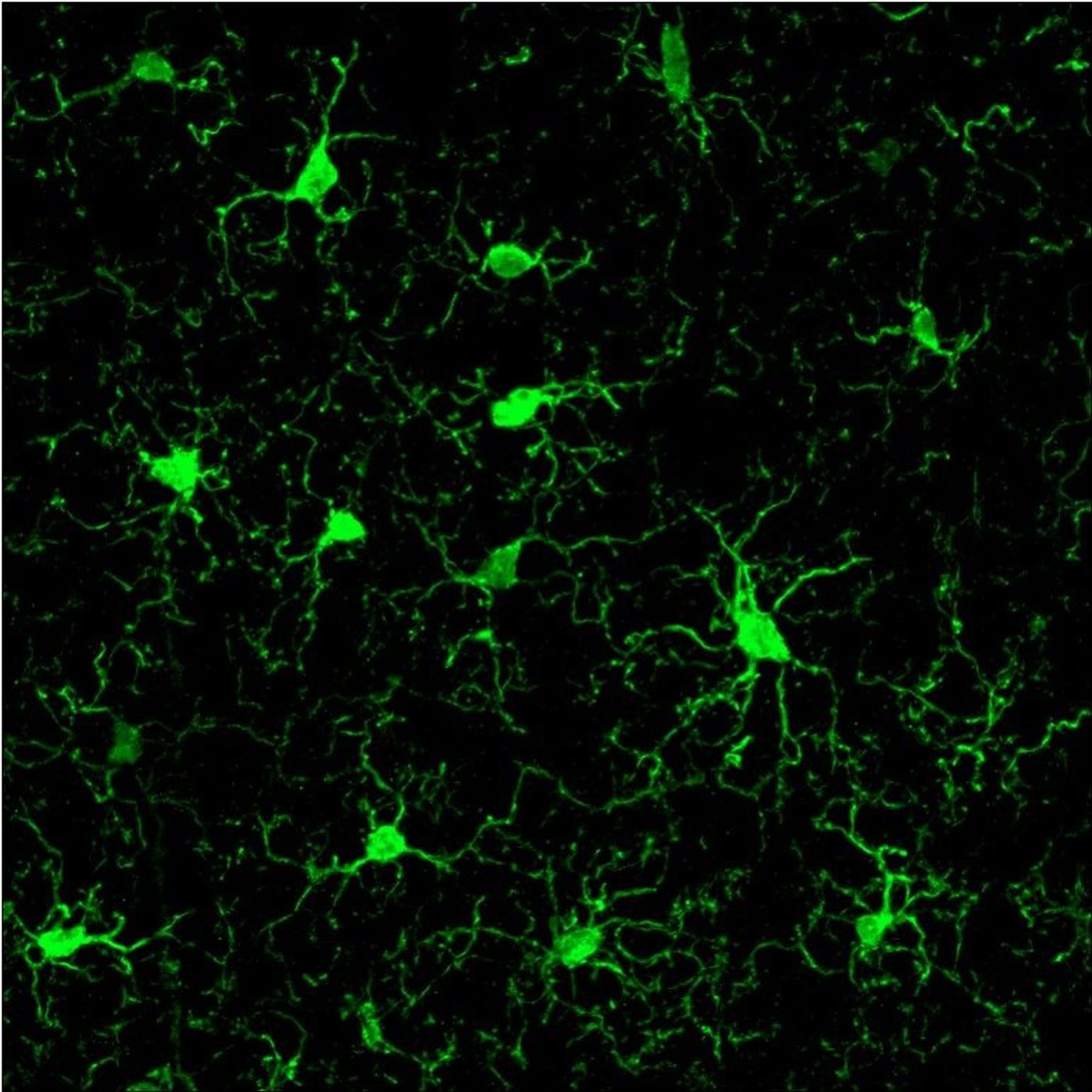
Molly's note about the image:

Those neon green things in the image are microglia, the brain’s immune cells, or, as we describe them in our episode, the janitor cells of the brain. Straight from MIT’s research files, this image shows microglia who have gotten light stimulation therapy (one can only hope in the flicker room). You can see their many, super-long tentacles, which would be used to feel out anything that didn’t belong in the brain. And then they’d eat it!

Further reading: 

Li-Huei and co’s gamma sound and light paper: Multi-sensory Gamma Stimulation Ameliorates Alzheimer’s-Associated Pathology and Improves Cognition


Hosted by Simplecast, an AdsWizz company. See pcm.adswizz.com for information about our collection and use of personal data for advertising.

No, wait, you're listening to Radio Lab from WNYC. Hey, I'm Jad, this is Radio Lab, so last week we heard a story from Molly Webster who's all about a new emerging disease, and this week, we're actually going to go back to Molly. Hello. Hey, there you are. Yay. High five. Because she has some new information about a story that she did a while back about beating back a disease, a disease that's been around for a while. So we're talking about, well, sorry, you start. No, we're talking about gamma, which is interesting because gamma was when you were gone. Yeah, I remember that. That's sabbatical. So here's the deal. It was 2016. I'd taken a little break from the show just a few months. And Molly, along with Robert, decided to do something a little bit different on the show. She actually broke some news. She'd gotten a hot tip about some research that was just out from MIT, and it was about Alzheimer's. And when I was there, they were in the midst of doing some really exciting follow-up research that they had told me about off the record, but they weren't ready to talk about. But now they are ready to talk about it. Okay. So here's what we're going to do. We're going to play the original piece. And then current day 2020, Molly and Jad will pop in along the way with some updates. But for now, here is 2016, Molly, with 2016. Robert. Hi, I'm Robert Krollich. I'm Molly Webster. This is RadioLab and today we've got breaking news, Robert Krollich. Great. This is something we've never done before. Never done before. What does anybody know about this yet? Well, it is a new bit of research that's being published today. We've known about it for the last few months, but we haven't been able to talk about it until now. What's this thing about? Oh, this is a discovery about Alzheimer's disease, which I think at this point is something that affects basically every family. Affected my family, yeah. Yeah. This is a discovery that is not a cure, but it's basically about looking at the brain, which is one of the most complicated things in the universe, I think, and poking at it in this super simple way and getting this bizarre result. How bizarre? It's pretty, pretty bizarre. Hello.

Transcription truncated.

Today, we return to the lab of neuroscientist Li-Huei Tsai, which brought us one of our favorite stories from four years ago - about the power of flashing lights on an Alzheimer’s-addled (mouse) brain. In this update, Li-Huei tells us about her team’s latest research, which now includes flashing sound, and ways in which light and sound together might retrieve lost memories. This new science is not a cure, and is far from a treatment, but it’s a finding so … simple, you won’t be able to shake it. Come join us for a lab visit, where we’ll meet some mice, stare at some light, and come face-to-face with the mystery of memory. We can promise you: by the end, you’ll never think the same way about Christmas lights again. Or jingle bells. This update was reported by Molly Webster, and produced by Rachael Cusick. The original episode was produced by Annie McEwen, Matt Kielty, and Molly Webster, with help from Simon Adler.  Special thanks to Ed Boyden, Cognito Therapeutics, Brad Dickerson, Karen Duff, Zaven Khachaturian, Michael Lutz, Kevin M. Spencer, and Peter Uhlhaas. Support Radiolab by becoming a member today at Radiolab.org/donate.     Molly's note about the image: Those neon green things in the image are microglia, the brain’s immune cells, or, as we describe them in our episode, the janitor cells of the brain. Straight from MIT’s research files, this image shows microglia who have gotten light stimulation therapy (one can only hope in the flicker room). You can see their many, super-long tentacles, which would be used to feel out anything that didn’t belong in the brain. And then they’d eat it! Further reading:  Li-Huei and co’s gamma sound and light paper: Multi-sensory Gamma Stimulation Ameliorates Alzheimer’s-Associated Pathology and Improves Cognition