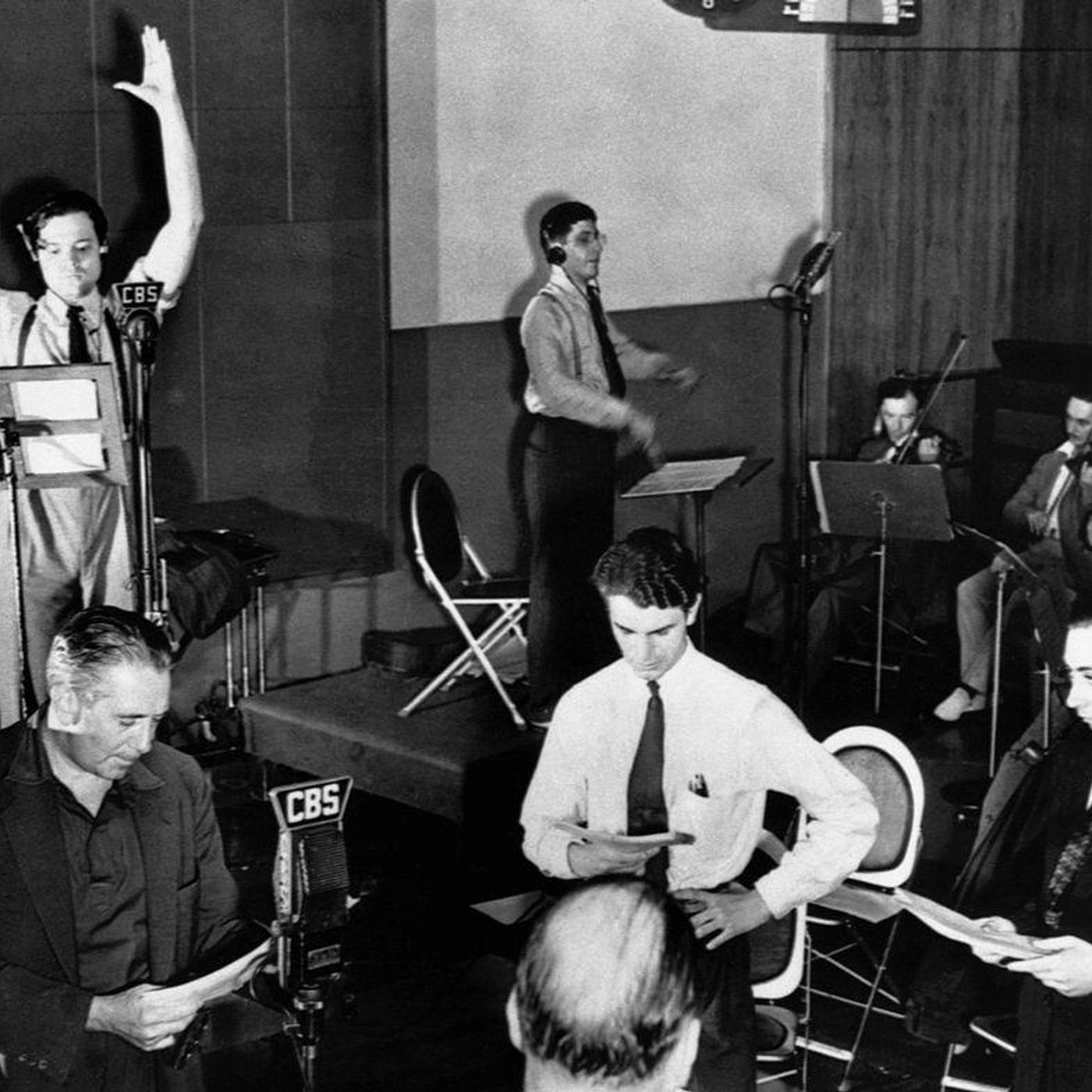
It's been 80 years to the day since Orson Welles' infamous radio drama "The War of the Worlds" echoed far and wide over the airwaves. So we want to bring you back to our very first live hour, where we take a deep dive into what was one of the most controversial moments in broadcasting history. "The War of the Worlds," a radio play about Martians invading New Jersey, caused panic when it originally aired, and it's continued to fool people since--from Santiago, Chile to Buffalo, New York to a particularly disastrous evening in Quito, Ecuador.
Support Radiolab today at Radiolab.org/donate.
Duration
1h 1m
Broadcast on
30 Oct 2018
Audio Format
other
This episode appears to contain dynamically inserted ads. Transcript timestamps may be approximate.
It's been 80 years to the day since Orson Welles' infamous radio drama "The War of the Worlds" echoed far and wide over the airwaves. So we want to bring you back to our very first live hour, where we take a deep dive into what was one of the most controversial moments in broadcasting history. "The War of the Worlds," a radio play about Martians invading New Jersey, caused panic when it originally aired, and it's continued to fool people since--from Santiago, Chile to Buffalo, New York to a particularly disastrous evening in Quito, Ecuador.
Hosted by Simplecast, an AdsWizz company. See pcm.adswizz.com for information about our collection and use of personal data for advertising.
Hi, I'm Robert Krollwich. Radio Lab is supported by the Netflix film The Love Me When I'm Dead. This is a movie that chronicles the last years of Orson Welles's life. He's the genius behind Citizen Kane. It's wildly entertaining, full of nuance and depth. The Love Me When I'm Dead, directed by Morgan Neville, only on Netflix November 2nd. Wait, you're listening? Okay. All right. Okay. All right. You're listening to Radio Lab. Radio Lab. From W.N.Y.C. See? Yeah. Hey, I'm John Iberron. I'm Robert Krollwich. This is Radio Lab. And today we are celebrating a multiple set of anniversaries because it was 80 years ago, 80 years ago that Orson Welles and the Mercury Theater decided to allow Martians to invade the state of New Jersey. It's one of the most famous broadcasts in broadcast history because it freaked people out. Yes. And then merely 10 years ago, we decided to take another look at this broadcast, which has gotten very complicated and layered and disputed in some ways over time. We are now celebrating our 10th. They're celebrating their 80th. So along with Orson Welles, whom I'm afraid couldn't be here tonight. We would like to present our homage to, I guess, to microbes. Yeah. To the little earthlings that saved the planet. Right. So in honor of the microbes, in honor of War of the Worlds, which broadcast 80 years ago today, tonight, here is our take on War of the Worlds.
October 30th, 1938. On that night, the United States experienced a kind of mass hysteria that we had never seen before. And the reason, which today sounds almost comical, was a radio play. The affiliated stations present Orson Welles and the Mercury Theater on the air in the War of the Worlds. The War of the Worlds.
Around 12 million people were listening, most got the joke. It was Halloween, after all. But if you consider that about one out of every 12 people didn't get the joke, that's what surveys found afterwards. About one out of every 12 people who heard the broadcast thought it was true and that some percentage of that one million people ran out of their homes, towels over their faces, clutching children, tripping, breaking limbs. Well, that constitutes a major freak out. And in this, our first ever Live Hour on Radio Lab here at St. Paul, Minnesota, at the
Transcription truncated.
It's been 80 years to the day since Orson Welles' infamous radio drama "The War of the Worlds" echoed far and wide over the airwaves. So we want to bring you back to our very first live hour, where we take a deep dive into what was one of the most controversial moments in broadcasting history. "The War of the Worlds," a radio play about Martians invading New Jersey, caused panic when it originally aired, and it's continued to fool people since--from Santiago, Chile to Buffalo, New York to a particularly disastrous evening in Quito, Ecuador.
Support Radiolab today at Radiolab.org/donate.