ArchiveFM

Last May, two research groups announced a breakthrough: they each grew human embryos, in the lab, longer than ever before. In doing so, they witnessed a period of human development no one had ever seen. But in the process, they crashed up against something called the '14-day rule,' a guideline set over 30 years ago that dictates what we do, and possibly how we feel, about human embryos in the lab. On this episode, join producer Molly Webster as she peers down at our very own origins, and wonders: what do we do now? This piece was produced by Molly Webster and Annie McEwen, with help from Matt Kielty. Special thanks goes to the Bioethics Research Library at Georgetown University; Omar Sultan Haque, Kevin Fitzgerald, SJ, and Josephine Johnston; Charlie McCarthy; Elizabeth Lockett, Mark Hill, and Robert Cork; plus, Eric Boodman, Lauren Morello, and Martin Pera. Producer's note about the image: Check out the super cool picture that's running with this piece. Scientist Gist Croft sent it to me a couple of weeks after my visit to the Rockefeller lab: it’s an image of the very embryo I looked at under the microscope - a twelve-day old human embryo - but with all the detail highlighted using fluorescent dye. (When I looked in person, we were using a light microscope that showed everything in black and white, with not nearly that precision.) The neon green bits are what's called the epiblast, the clump of cells from which the entire human body develops. See how it looks like it's pulling apart in to two? The scientists don’t know for sure, but they think this embryo might have been on it's way to becoming TWO embryos. Twinning! In action! Support Radiolab by becoming a member today at Radiolab.org/donate.    
Duration
32m
Broadcast on
23 Sep 2016
Audio Format
other

Last May, two research groups announced a breakthrough: they each grew human embryos, in the lab, longer than ever before. In doing so, they witnessed a period of human development no one had ever seen. But in the process, they crashed up against something called the '14-day rule,' a guideline set over 30 years ago that dictates what we do, and possibly how we feel, about human embryos in the lab.

On this episode, join producer Molly Webster as she peers down at our very own origins, and wonders: what do we do now?

This piece was produced by Molly Webster and Annie McEwen, with help from Matt Kielty.

Special thanks goes to the Bioethics Research Library at Georgetown University; Omar Sultan Haque, Kevin Fitzgerald, SJ, and Josephine Johnston; Charlie McCarthy; Elizabeth Lockett, Mark Hill, and Robert Cork; plus, Eric Boodman, Lauren Morello, and Martin Pera.

Producer's note about the image:

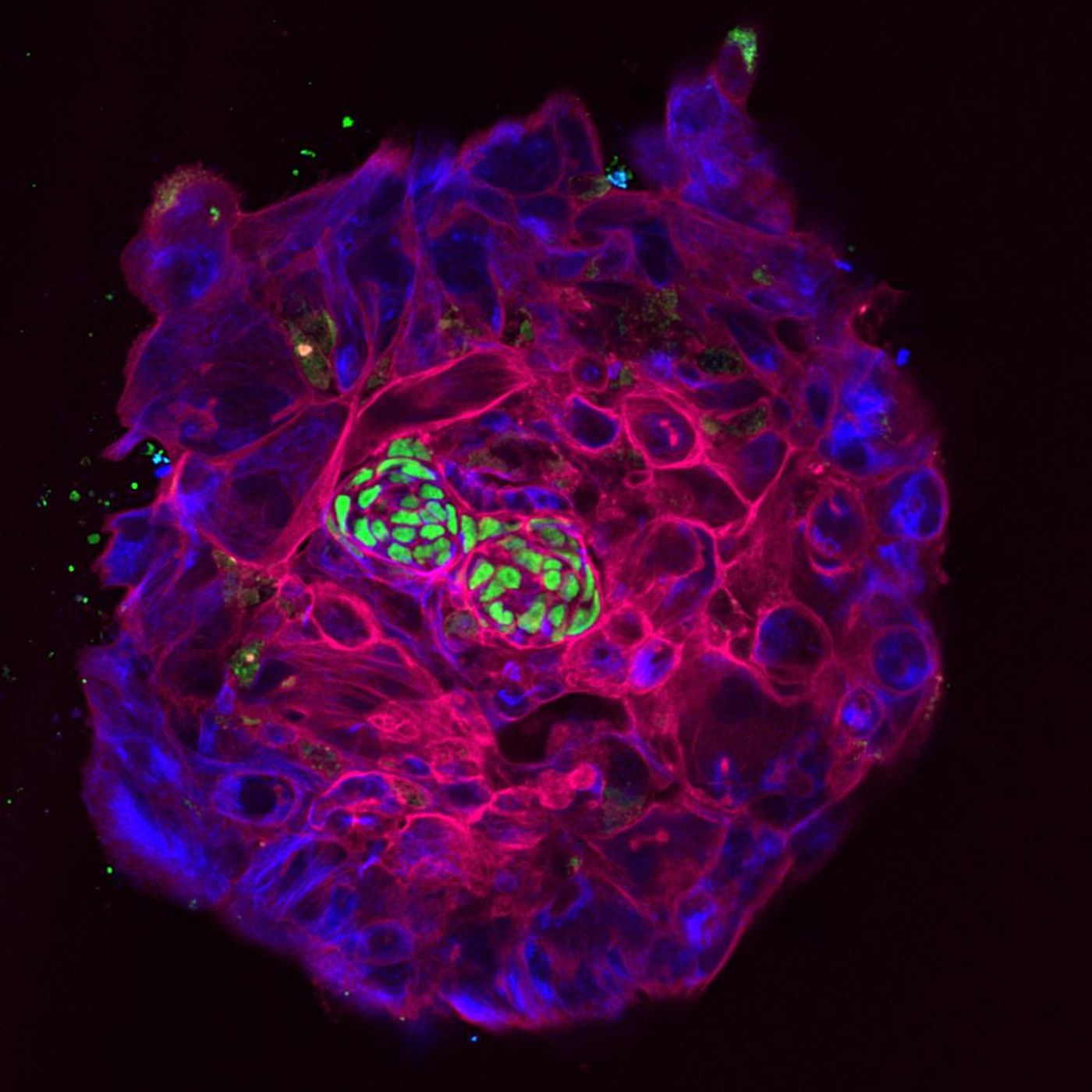
Check out the super cool picture that's running with this piece. Scientist Gist Croft sent it to me a couple of weeks after my visit to the Rockefeller lab: it’s an image of the very embryo I looked at under the microscope - a twelve-day old human embryo - but with all the detail highlighted using fluorescent dye. (When I looked in person, we were using a light microscope that showed everything in black and white, with not nearly that precision.) The neon green bits are what's called the epiblast, the clump of cells from which the entire human body develops. See how it looks like it's pulling apart in to two? The scientists don’t know for sure, but they think this embryo might have been on it's way to becoming TWO embryos. Twinning! In action!

Support Radiolab by becoming a member today at Radiolab.org/donate.    


Hosted by Simplecast, an AdsWizz company. See pcm.adswizz.com for information about our collection and use of personal data for advertising.

3D Lab is supported by AT&T. We all love to connect via video calls or texts. Right now at AT&T, you can get the new iPhone 18 Pro for $0 with iPhone trade-in, any condition. It has the ultimate pro camera system and big leap in battery life so you can turn this deal into a long lasting connection. Learn how you can trade in your iPhone for the new iPhone 18 Pro requires trade-in of iPhone 14 or higher excluding iPhone 16E and eligible plan. Terms and restrictions apply subject to change, visit an AT&T store for details. We're going to start with a conversation that I had with Jad a few weeks ago. Okay. So, I like medical stories. Yes, I know about you. Yes, you know. And so I read this website called statnews.com, which does sort of really, it's like a new website out of Boston. It's new, right? It just started. And basically, it's this collection of really amazing like medical reporters. And I will click on stories that look interesting. There was one about, we've just grown embryos, human embryos, for a long time in a lab. And that was when I read the phrase, the 14-day rule for the first time, and it was that apparently there's this thing that you can't grow an embryo in a lab past 14 days, which I didn't even know you could grow an embryo in a lab at all, or that people were, or that, I mean, I guess I knew IVF happened, like test tube babies. How long, in the average IVF situation, how long is an embryo in a dish for? And then I realized I didn't actually even know that either. So then I just spun out. So like, the whole article is just interesting to me because I was like, I don't know about any of this. Right. Right. I'm Molly Webster. Oh, and I'm Robert Krollich. This is RadioLab. And today on RadioLab, we're going to zip down a wormhole into another universe, and Robert, you're coming with me. What can you tell me about this universe before I buy a ticket? Oh, you're okay. You're going to want to buy a ticket because in this universe are twins, and souls, and mice, and something called a primitive streak, and they're all gathered together around a certain rule. Oh, and am I making what the rule was? Well, so you know how you can fertilize an egg, you get an egg and a sperm and you put them together. Yes. Fertilize is the egg. Right. And then the egg, the fertilized egg, it multiplies, multiplies, cell divides. So scientists could take it to watch it grow, to learn about human development. But then they have to stop at day 14.

Transcription truncated.

Last May, two research groups announced a breakthrough: they each grew human embryos, in the lab, longer than ever before. In doing so, they witnessed a period of human development no one had ever seen. But in the process, they crashed up against something called the '14-day rule,' a guideline set over 30 years ago that dictates what we do, and possibly how we feel, about human embryos in the lab. On this episode, join producer Molly Webster as she peers down at our very own origins, and wonders: what do we do now? This piece was produced by Molly Webster and Annie McEwen, with help from Matt Kielty. Special thanks goes to the Bioethics Research Library at Georgetown University; Omar Sultan Haque, Kevin Fitzgerald, SJ, and Josephine Johnston; Charlie McCarthy; Elizabeth Lockett, Mark Hill, and Robert Cork; plus, Eric Boodman, Lauren Morello, and Martin Pera. Producer's note about the image: Check out the super cool picture that's running with this piece. Scientist Gist Croft sent it to me a couple of weeks after my visit to the Rockefeller lab: it’s an image of the very embryo I looked at under the microscope - a twelve-day old human embryo - but with all the detail highlighted using fluorescent dye. (When I looked in person, we were using a light microscope that showed everything in black and white, with not nearly that precision.) The neon green bits are what's called the epiblast, the clump of cells from which the entire human body develops. See how it looks like it's pulling apart in to two? The scientists don’t know for sure, but they think this embryo might have been on it's way to becoming TWO embryos. Twinning! In action! Support Radiolab by becoming a member today at Radiolab.org/donate.