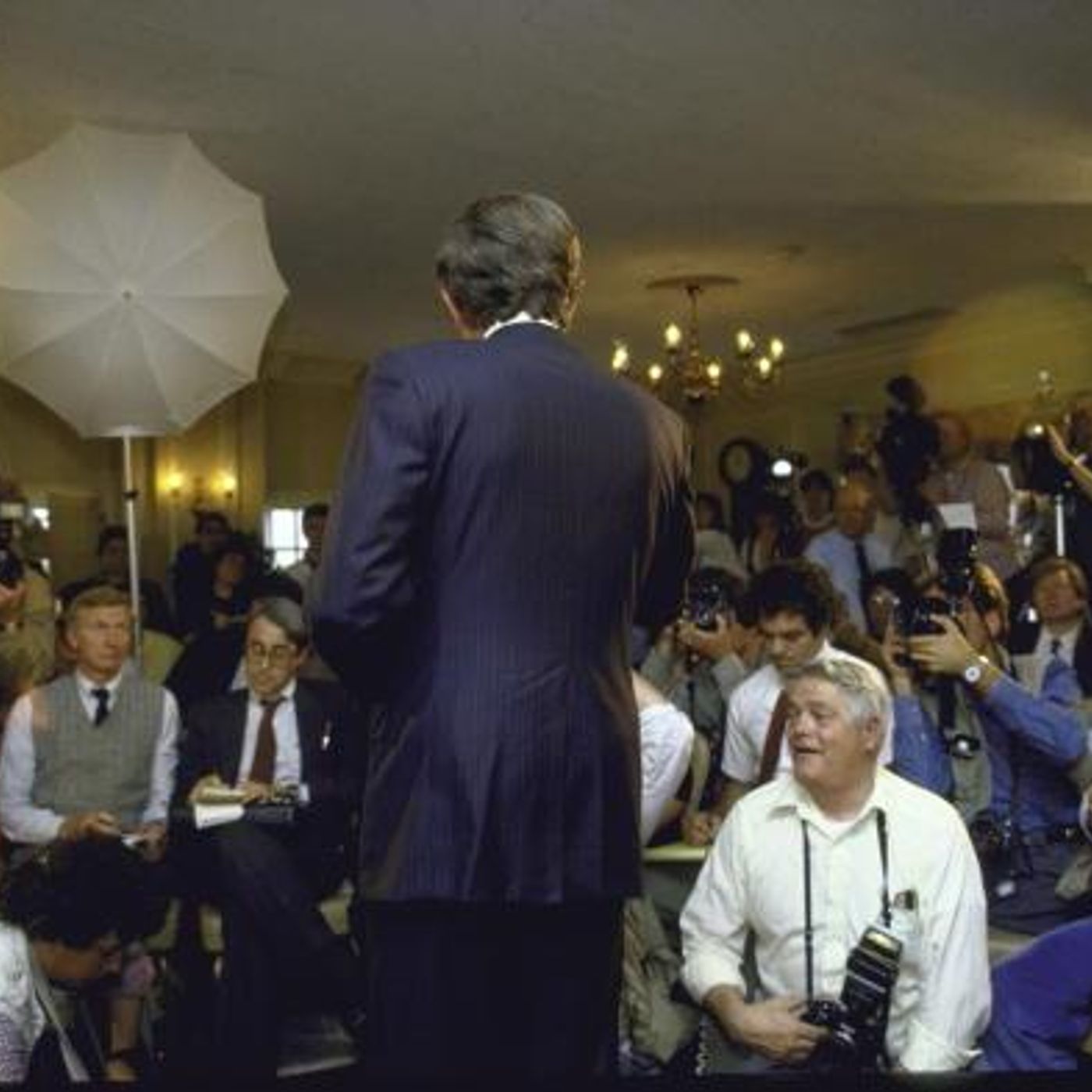
Roosevelt, Kennedy, Eisenhower … they all got a pass. But today we peer back at the moment when poking into the private lives of political figures became standard practice.
In 1987, Gary Hart was a young charismatic Democrat, poised to win his party’s nomination and possibly the presidency. Many of us know the story of what happened next, and even if you don’t, it’s a familiar tale. But at the time, politicians and political reporters found themselves in uncharted territory. With help from author Matt Bai, we look at how the events of that May shaped the way we cover politics, and expanded our sense of what's appropriate when it comes to judging a candidate.
Produced by Simon Adler
Special Thanks to Joe Trippi
Duration
37m
Broadcast on
29 Jan 2016
Audio Format
other
This episode appears to contain dynamically inserted ads. Transcript timestamps may be approximate.
Roosevelt, Kennedy, Eisenhower … they all got a pass. But today we peer back at the moment when poking into the private lives of political figures became standard practice.
In 1987, Gary Hart was a young charismatic Democrat, poised to win his party’s nomination and possibly the presidency. Many of us know the story of what happened next, and even if you don’t, it’s a familiar tale. But at the time, politicians and political reporters found themselves in uncharted territory. With help from author Matt Bai, we look at how the events of that May shaped the way we cover politics, and expanded our sense of what's appropriate when it comes to judging a candidate.
Produced by Simon Adler
Special Thanks to Joe Trippi
Hosted by Simplecast, an AdsWizz company. See pcm.adswizz.com for information about our collection and use of personal data for advertising.
WNYC Studios is supported by ODU. When you buy business software from lots of vendors, the costs add up and it gets complicated and confusing. ODU solves this. It's a single company that sells a suite of enterprise apps that handles everything from accounting to inventory to sales. ODU is all connected on a single platform in a simple and affordable way. You can save money without missing out on the features you need. Check out ODU at ODOO.com. That's ODOO.com. Wait, you're listening to Radiolab. From WNYC. Hey, I'm Jad Abumrod. I'm Robert Krollich. This is Radiolab. Here we are in this moment where we're about to get started with another election cycle. Another Iowa, another New Hampshire, Carolina, all of that. This is the time when we reporters decide, "Well, we're going to have to tell you some stuff and you're going to have to decide what matters to you." The story that we're going to tell in this podcast is about a moment, a shockingly recent moment. That's how I felt when I first heard this story. A moment of when what reporters decide to tell and what people decide to value really changed. So, we're going to take you back to an evening in 1987, Tom Fiedler, a political reporter for the Miami Herald. It's late at night and he's in his office. I was at my desk and just in fact packing up to go home, my phone rang and I'm thinking, "Oh, it's probably my wife and she's wondering why I haven't left yet." I said, "All right, I'll pick it up." When he picked up the phone, it turned out it was not a voice he recognized. It was a woman's voice, maybe in her late 20s. And she said to him, "I have something you need to know." It was a tip about one of the most powerful and charismatic men in American politics, former Senator Gary Hart, who at the time was not only the most likely candidate to become the Democratic nominee, he was very possibly going to be the next president of the United States. Her words to me were, "Gary Hart is having an affair with one of my best friends." And she told him, "Basically, I can prove it." And, you know, I was rather, I guess, dumbstruck by that. And he thought, "Well, now what do we do?" Now, if you're of a certain age, you probably remember this story, you probably know what happens next, but even if you've never heard of Gary Hart, you still probably know the outline of this story, the accusations... And then the denial... "I did not have sexual relations with that woman." And then after that, the whole wall-to-wall media thing, which just goes on and on and on until you want to take your head off your shoulders, put it on the sidewalk, and beat it with a baseball bat. But the thing that's easy to forget is that it wasn't always like this. No, Hart was the first to walk into this vortex of social forces. And after that, the rules of political journalism and politics change almost immediately. That, by the way, is met by... National political columnist for Yahoo News. He wrote a book about this incident, which he called "All the Truth is Out." And in that book, he makes you agree that this is the moment Gary Hart, 1987, when political journalism slid off the rails. Or, you might argue, when it finally got serious. Well, you know, it's flashback a minute, because I think the context is important. 1984. Hart kind of comes from nowhere...
Transcription truncated.
Roosevelt, Kennedy, Eisenhower … they all got a pass. But today we peer back at the moment when poking into the private lives of political figures became standard practice.
In 1987, Gary Hart was a young charismatic Democrat, poised to win his party’s nomination and possibly the presidency. Many of us know the story of what happened next, and even if you don’t, it’s a familiar tale. But at the time, politicians and political reporters found themselves in uncharted territory. With help from author Matt Bai, we look at how the events of that May shaped the way we cover politics, and expanded our sense of what's appropriate when it comes to judging a candidate.
Produced by Simon Adler
Special Thanks to Joe Trippi