Shrink
The definition of life is in flux, complexity is overrated, and humans are shrinking.
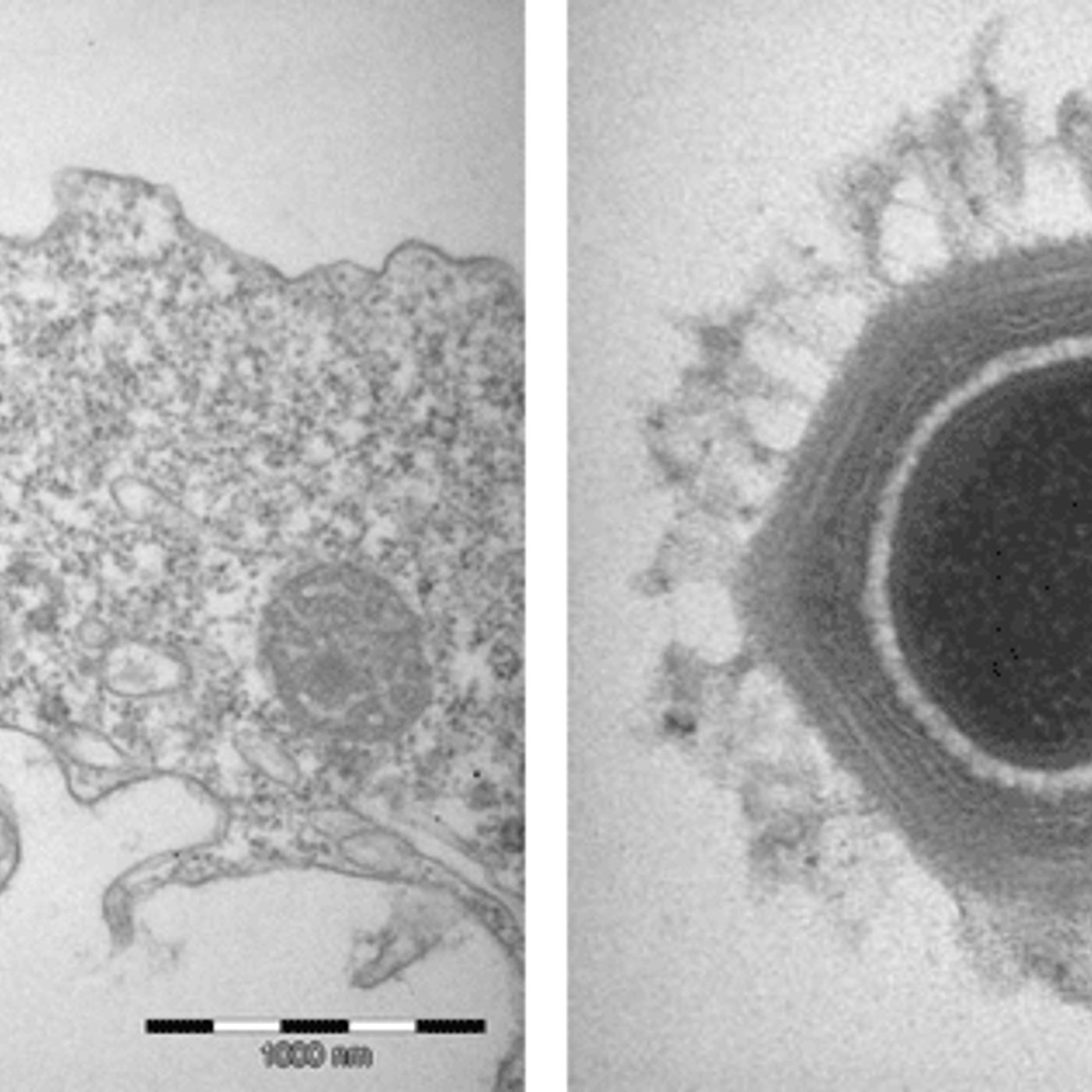
Viruses are supposed to be sleek, pared-down, dead-eyed machines. But when one microbiologist stumbled upon a GIANT virus, hundreds of times bigger than any seen before, all that went out the window. The discovery opened the door not only to a new cast of microscopic characters with names like Mimivirus, Mamavirus, and Megavirus, but also to basic questions: How did we miss these until now? Have they been around since the beginning? What if evolution could go … backwards?
Join Jad and Robert as they grill Radiolab regular Carl Zimmer on these paradoxical viruses – they’re so big that they can get their own viruses! - and what they can tell us about the nature of life.
- Duration
- 47m
- Broadcast on
- 30 Jul 2015
- Audio Format
- other
This episode appears to contain dynamically inserted ads. Transcript timestamps may be approximate.
The definition of life is in flux, complexity is overrated, and humans are shrinking.
Viruses are supposed to be sleek, pared-down, dead-eyed machines. But when one microbiologist stumbled upon a GIANT virus, hundreds of times bigger than any seen before, all that went out the window. The discovery opened the door not only to a new cast of microscopic characters with names like Mimivirus, Mamavirus, and Megavirus, but also to basic questions: How did we miss these until now? Have they been around since the beginning? What if evolution could go … backwards?
Join Jad and Robert as they grill Radiolab regular Carl Zimmer on these paradoxical viruses – they’re so big that they can get their own viruses! - and what they can tell us about the nature of life.
Hosted by Simplecast, an AdsWizz company. See pcm.adswizz.com for information about our collection and use of personal data for advertising.
This video is supported by AT&T. We all love to connect via video calls or texts. Right now, at AT&T, you can get the new iPhone 18 Pro for $0 with iPhone trade-in. Any condition. It has the ultimate pro camera system and big leap in battery life, so you can turn this deal into a long-lasting connection. Learn how you can trade in your iPhone for the new iPhone 18 Pro requires trade-in of iPhone 14 or higher, excluding iPhone 16E, and eligible plan. Terms and restrictions apply, subject to change, visit an AT&T store for details. You guys can't say we want to talk to you about three videos. Ok, let's do that. Hey, this is Radio Lab. I'm Jad Apple Marad. I want to do something that's a little bit unorthodox today, at least for us. If you've listened to the show in the last 10 years or so, how long we've been doing this, you understand that we like to edit, right? We like a good edit, or 70, but today I want to play you something that has almost no edits at all. It's just a conversation, which is of course the foundation of what we do. These long, rambling, occasionally profane, error strewn conversations that we then edit into something coherent, but today I want to show you the messiness, no edits. This is a chunk of a conversation with science writer Carl Zimmer. He came and sat down with us a while back, and we talked for four hours. Two of those hours became the basis for the CRISPR podcast that was a few podcasts ago. This was about gene editing, but then we kept on going for another two hours, and he told us this story, actually two stories, but we're only going to play one, that I thought was really cool. It's about this new way of looking at life. Is this a long story, a medium story or a short story? It's not a, we can get through this a lot faster than CRISPR. Okay. I really like CRISPR, by the way. So do I. I mean, CRISPR is, yeah, it's the bomb. Yeah, that's a perfect way to describe it, by a logical bomb. Okay. So, chapter two. Okay. Maybe you can start the story once at the once upon a time. Sure. So, once upon a time being, I'd say once upon a time being before 2003, we basically had two kinds of living things on Earth. We had cellular life, and we had viruses, and there was nice and distinct and clear cut. And so, cells included us, because our bodies have made our cells, and bacteria, which are single-celled, and all the other things that can grow and let their cells divide. They have DNA, they have proteins in them, they all have that stuff. And then, over here, you had viruses, and viruses were just little packages of genetic material that would go from cell to cell and use the cell to make new viruses. And so, inside of them, all they had were genes and a couple proteins that would then sort of hijack their host.
Transcription truncated.
The definition of life is in flux, complexity is overrated, and humans are shrinking.
Viruses are supposed to be sleek, pared-down, dead-eyed machines. But when one microbiologist stumbled upon a GIANT virus, hundreds of times bigger than any seen before, all that went out the window. The discovery opened the door not only to a new cast of microscopic characters with names like Mimivirus, Mamavirus, and Megavirus, but also to basic questions: How did we miss these until now? Have they been around since the beginning? What if evolution could go … backwards?
Join Jad and Robert as they grill Radiolab regular Carl Zimmer on these paradoxical viruses – they’re so big that they can get their own viruses! - and what they can tell us about the nature of life.