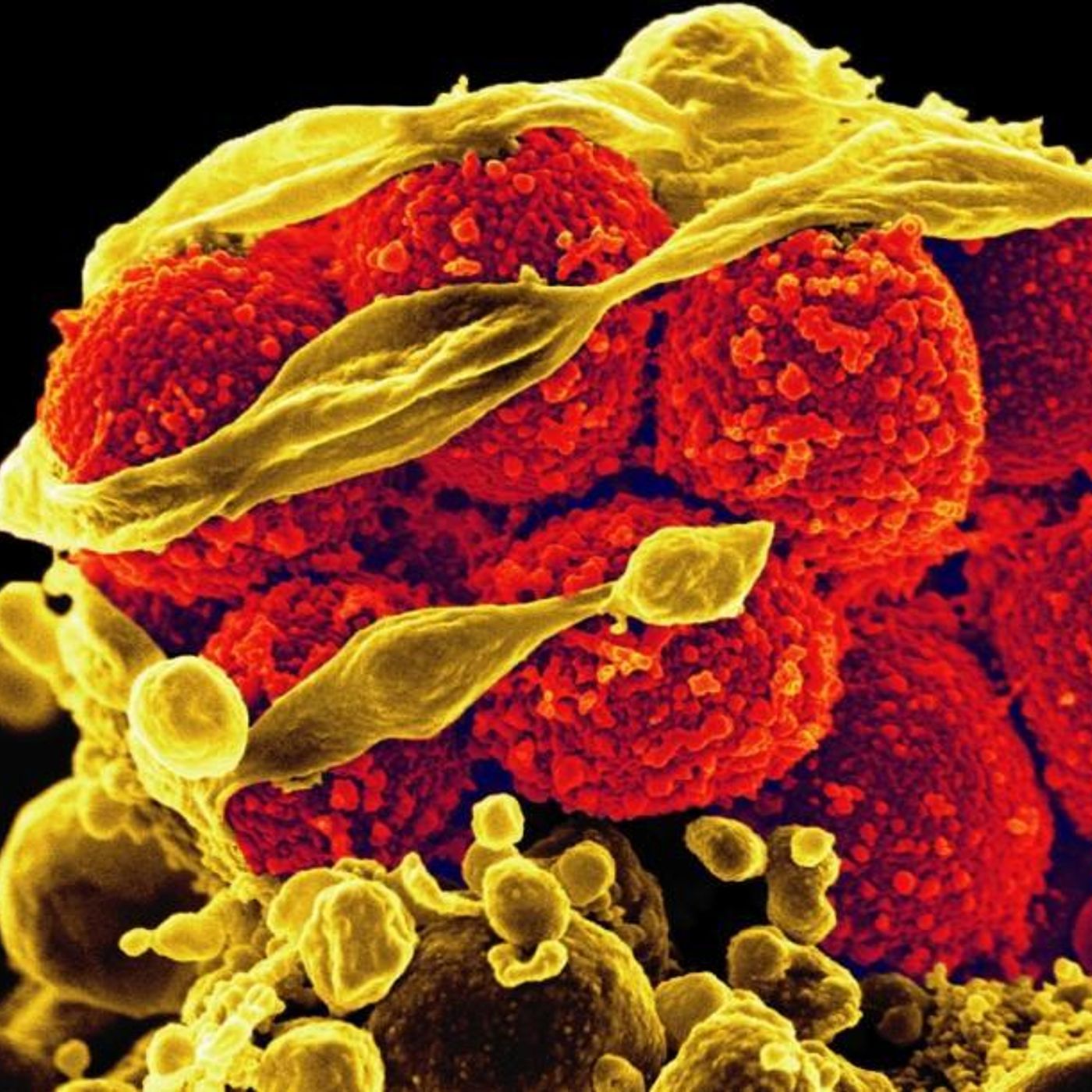
Hidden inside some of the world’s smallest organisms is one of the most powerful tools scientists have ever stumbled across. It's a defense system that has existed in bacteria for millions of years and it may some day let us change the course of human evolution.
Out drinking with a few biologists, Jad finds out about something called CRISPR. No, it’s not a robot or the latest dating app, it’s a method for genetic manipulation that is rewriting the way we change DNA. Scientists say they’ll someday be able to use CRISPR to fight cancer and maybe even bring animals back from the dead. Or, pretty much do whatever you want. Jad and Robert delve into how CRISPR does what it does, and consider whether we should be worried about a future full of flying pigs, or the simple fact that scientists have now used CRISPR to tweak the genes of human embryos.
As of February 24th, 2017 we've updated this story.
Duration
34m
Broadcast on
06 Jun 2015
Audio Format
other
This episode appears to contain dynamically inserted ads. Transcript timestamps may be approximate.
Hidden inside some of the world’s smallest organisms is one of the most powerful tools scientists have ever stumbled across. It's a defense system that has existed in bacteria for millions of years and it may some day let us change the course of human evolution.
Out drinking with a few biologists, Jad finds out about something called CRISPR. No, it’s not a robot or the latest dating app, it’s a method for genetic manipulation that is rewriting the way we change DNA. Scientists say they’ll someday be able to use CRISPR to fight cancer and maybe even bring animals back from the dead. Or, pretty much do whatever you want. Jad and Robert delve into how CRISPR does what it does, and consider whether we should be worried about a future full of flying pigs, or the simple fact that scientists have now used CRISPR to tweak the genes of human embryos.
Hosted by Simplecast, an AdsWizz company. See pcm.adswizz.com for information about our collection and use of personal data for advertising.
WNYC Studios is supported by WISE. WISE, the smart way to manage the currencies you need around the world. With a WISE account, you can send, spend, and receive in up to 40 currencies with only a few simple taps. Be smart, get WISE. Download the WISE app today. Terms and conditions apply. WNYC Studios is supported by Odo. When you buy business software from lots of vendors, the costs add up and it gets complicated and confusing. Odo solves this. It's a single company that sells a suite of enterprise apps that handles everything from accounting to inventory to sales. Odo is all connected on a single platform in a simple and affordable way. You can save money without missing out on the features you need. Check out Odo at ODOO.com. That's O-D-O-O.com. Wait, you're listening to RadioLab from WNYC and NPR. This is RadioLab. I'm Jad Abumran. I'm Robert Krollowich. Let me explain to you how I got started with this. You were some kind of an affair? Yeah. I'll tell you how I was at a party. It was a conference where a lot of different people of different disciplines come together. One of those. There are panel discussions with various things. We were at one of the functions and it was a situation where dinner hadn't yet been served and there was a lot of booze being served. Everybody was drunk on an empty stomach. I was standing there with some biologists. Oh, they're the fun ones. They're junk biologists, yes. My people, apparently. They started to lose their shit, genuinely lose their shit about this thing called CRISPR. I've never seen scientists this excited about anything, so I was like, "What is this thing? What is CRISPR?" They were trying to explain it to me, but they couldn't slow down enough for me to get it. I gathered at something to do with genetics, and then at one point, one of the biologists turned to me. He was like, "I'll tell you what it is." "I can use CRISPR to take a little dog and poof make it into a big dog. Give me a chihuahua. I could turn it into the size of a great dain." I was like, "No, you can't." He's like, "Yes, I can. I could do it with CRISPR." I was like, "What the hell is this thing?" You want me to sit here as usual? Yeah, if you sit here, I will get out. Let me know I'm flying anywhere. No, no, no. We'd be sitting here together. So what happened was I came back and I immediately called science writer Carl Zimmer because I just figured for this kind of thing, this is a Carl thing. I got to talk to Carl. So I basically asked him, like, "Why all the fuss? Maybe it was just the alcohol, or maybe there's something really happening here?" Oh, there's something totally happening here. I mean, it's big. He started at the beginning. So you can actually find the first reference to CRISPR in a 1987 paper from some Japanese scientists. They basically described something weird in E. coli, and they said, "We don't know what this is." E. coli are bacteria inside humans, and like all living things, E. coli's made up of DNA, A's and T's and C's and G's, and what happened was that these scientists were reading a chunk of that genetic code when... They found this really strange stretch of DNA. Strange how? Well, so basically what it was was five identical sequences in a row, and then they were separated by very short sequences in between them that were all different from each other. These little blurps would be like, and they looked at this and they're like, "What? This is nothing like we've seen before." Repeated sequences in bacterial genomes are kind of unusual. Seems very strange. Some biologists felt that, you know, there must be a purpose for these. Among those purpose seekers? Jennifer Doudna, University of California, Berkeley. She's a cell biologist. Yeah. So it's Doudna, not Doudna. It's Doudna. I used to be called the dude sometimes in school. In the movie, she will be played by Jeff Bridges. Right. Anyhow, this time goes on. Scientists start seeing these little repeat blurp repeats everywhere, or at least some bacteria. Lots and lots and lots of species of bacteria. They say, "Hmm, okay, wait a minute. That's kind of cool." They're finding it so often that they decided they had to give it a name. And is this where the name CRISPR comes from? Yes. The full official name is clustered regularly interspaced short palindromic repeats. Oh my god. I don't know why they called it CRISPR. It's kind of a... CRISPR. It's like a furniture
Transcription truncated.
Hidden inside some of the world’s smallest organisms is one of the most powerful tools scientists have ever stumbled across. It's a defense system that has existed in bacteria for millions of years and it may some day let us change the course of human evolution.
Out drinking with a few biologists, Jad finds out about something called CRISPR. No, it’s not a robot or the latest dating app, it’s a method for genetic manipulation that is rewriting the way we change DNA. Scientists say they’ll someday be able to use CRISPR to fight cancer and maybe even bring animals back from the dead. Or, pretty much do whatever you want. Jad and Robert delve into how CRISPR does what it does, and consider whether we should be worried about a future full of flying pigs, or the simple fact that scientists have now used CRISPR to tweak the genes of human embryos.
As of February 24th, 2017 we've updated this story.