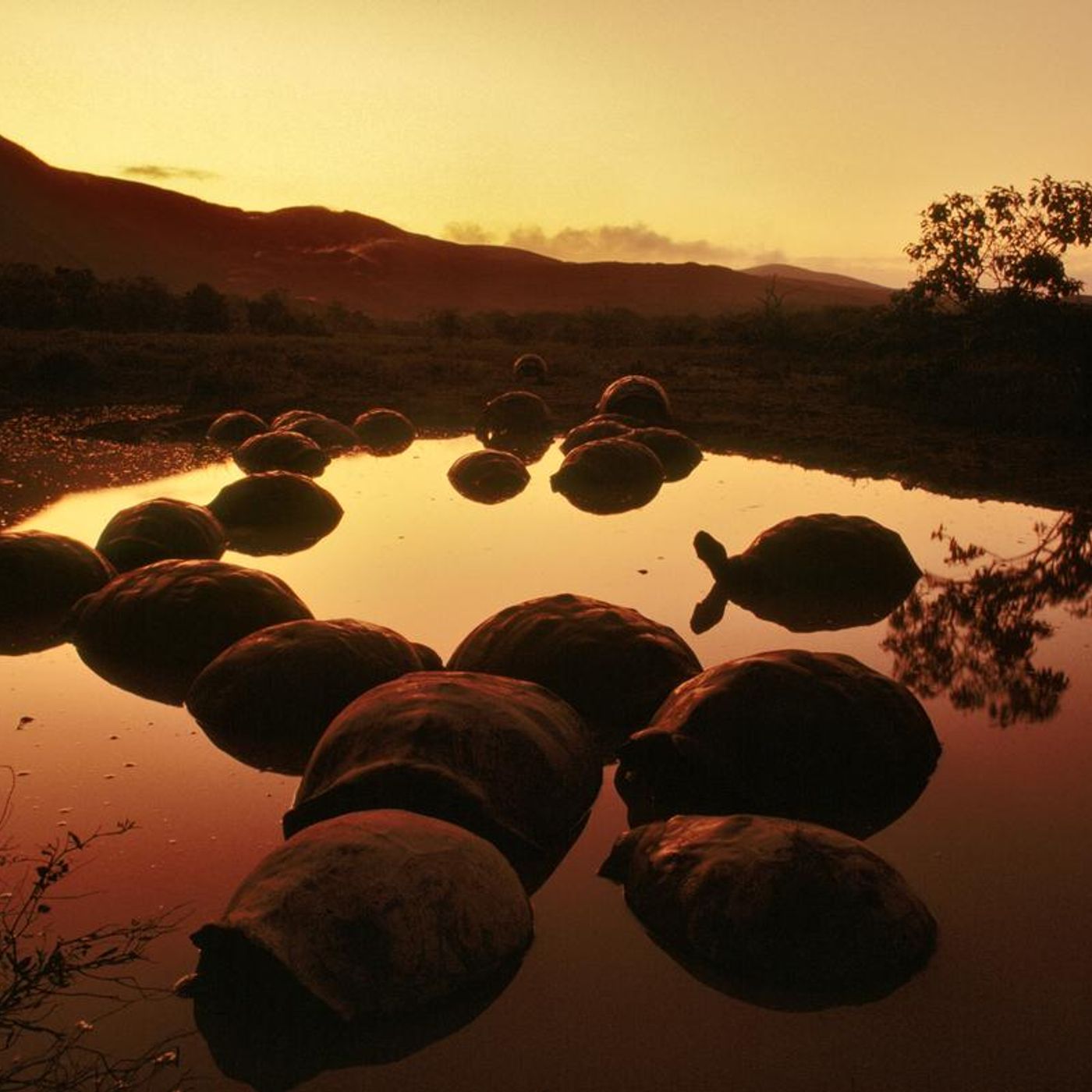
Today, the strange story of a small group of islands that raise a big question: is it inevitable that even our most sacred natural landscapes will eventually get swallowed up by humans? And just how far are we willing to go to stop that from happening?
We are dedicating a whole hour to the Galapagos archipelago, the place that inspired Darwin’s theory of evolution and natural selection. 179 years later, the Galapagos are undergoing rapid changes that continue to pose -- and possibly answer -- critical questions about the fragility and resilience of life on Earth.
For transcripts, see individual segment pages.
Duration
1h 5m
Broadcast on
17 Jul 2014
Audio Format
other
This episode appears to contain dynamically inserted ads. Transcript timestamps may be approximate.
Today, the strange story of a small group of islands that raise a big question: is it inevitable that even our most sacred natural landscapes will eventually get swallowed up by humans? And just how far are we willing to go to stop that from happening?
We are dedicating a whole hour to the Galapagos archipelago, the place that inspired Darwin’s theory of evolution and natural selection. 179 years later, the Galapagos are undergoing rapid changes that continue to pose -- and possibly answer -- critical questions about the fragility and resilience of life on Earth.
For transcripts, see individual segment pages.
Hosted by Simplecast, an AdsWizz company. See pcm.adswizz.com for information about our collection and use of personal data for advertising.
(swooshing) RadioLab is supported by AT&T. We all love to connect via video, a text, or a group chat that never stops. And right now, AT&T has a deal that will keep the connection going. You can get the new iPhone 18 Pro for $0 with eligible trade-in. It has the Ultimate Pro camera system and a big leap in battery life. So you can turn this deal into a long lasting connection. Learn how you can trade in your phone for the new iPhone 18 Pro at AT&T. Connecting changes everything. Required trade-in of $230 or more and eligible plan, terms, and restrictions apply, subject to change, visit an AT&T store for details. - Oh, wait, you're listening? - Okay. - Okay. - Okay. - Okay. (clears throat) - You're listening to RadioLab. - RadioLab. - RadioLab. - WNYC. - WNYC. - C. (laughing) - And NPR.
- Hey, I'm Chad Ippenrod. - I am Robert Krillwich. - This is RadioLab, and today, we begin on a plane. - Thank you, Brooke. - Which carried our newly married producer, Tim Howard, to the Galapagos. So I took the plane from Keto. We had just finished the honeymoon that morning, me and Brooke. (speaking in foreign language) They make announcements and at a certain point, the flight attendants, they open up all of the overhead bins and they walk up and down, spraying some sort of insecticide. - For what? - For like an invasive species, I think. - Yeah, like whatever bugs might've snuck on the plane. By this point, I'm getting super excited
Transcription truncated.
Today, the strange story of a small group of islands that raise a big question: is it inevitable that even our most sacred natural landscapes will eventually get swallowed up by humans? And just how far are we willing to go to stop that from happening?
We are dedicating a whole hour to the Galapagos archipelago, the place that inspired Darwin’s theory of evolution and natural selection. 179 years later, the Galapagos are undergoing rapid changes that continue to pose -- and possibly answer -- critical questions about the fragility and resilience of life on Earth.
For transcripts, see individual segment pages.