Happy Birthday, Good Dr. Sacks
This episode appears to contain dynamically inserted ads. Transcript timestamps may be approximate.
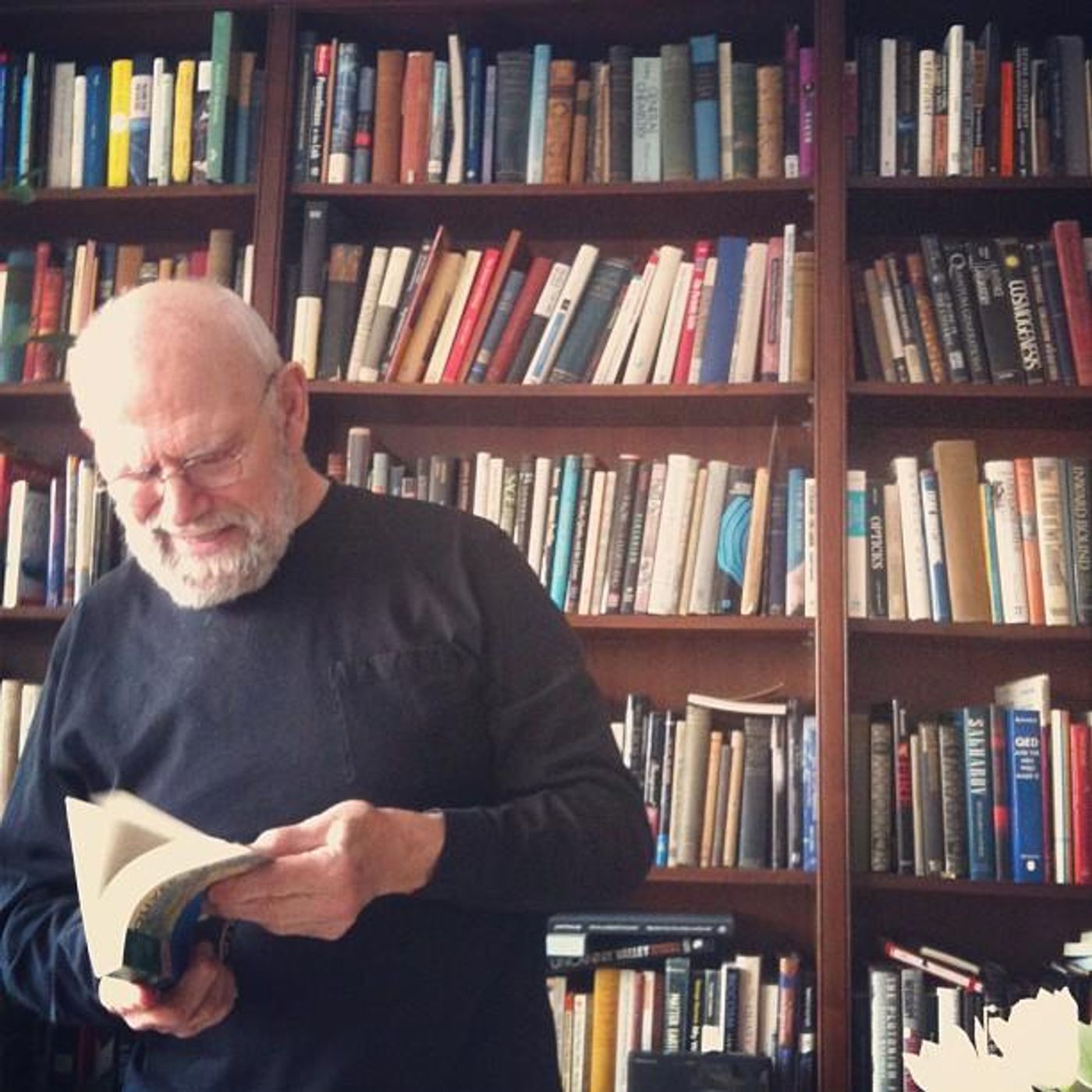
One of our favorite human beings turns 80 this week. To celebrate, Robert asks Oliver Sacks to look back on his career, and explain how thousands of worms and a motorbike accident led to a brilliant writing career.
Hosted by Simplecast, an AdsWizz company. See pcm.adswizz.com for information about our collection and use of personal data for advertising.
Oh, wait, you're listening to Radio Lab from WNYC and NPR. Hi, I'm Robert Krollwich. This is Radio Lab, the podcast. Chad is with his family this week, so it's just going to be me, although not me all by myself, because we're going to have a little birthday celebration for a guy who has been a contributor to this program, pretty much since it began. Dr. Oliver Sacks will be 80 years old this week. His essays about his patients, Awakenings, Man Who Was Took His Wife For Hat, they are a model for what we like to do around here, that mix of science and heart and curiosity. So I asked him, "Would you mind sitting down and talking to me about how you got started?" And he said, "Well, all right, the truth is, though. My start wasn't all that easy. In fact, it was kind of rough." I came to New York in '65. He wasn't planning to write essays about science, not at all. I wanted to be a real scientist. The kind that does experiments in a lab. And he had a research position at Einstein Medical Center in the Bronx, working with worms. Earthworms? Right, earthworms. I'm afraid I committed a sort of genocide of worms from the front garden at Einstein. I collected them by the hundred and by the thousand. How many altogether? Tens of thousands. The thing about worms is when you give them a little poke, you give them a look. They have very quick reactions, subtle reactions, when they curl up. They react faster than people do, and you wonder why. So he decided to focus on the wrappers that surround their nerve cells, which are made from a very thin substance called myelin. So then, you have to peel it off really delicately. One is looking for a little amount of myelin in their giant nerve fibers, maybe a thousandth of the weight of each worm. So you're digging up lots of earthworms. How do they die? Well, I don't want to be pressed on that point. Come on. Give me a little. We sort of anesthetize them and put them out. Until very gradually, he accumulated a precious ball of myelin that he could then take to a laboratory to experiment with. Of course, like any good scientist, he also took notes. I kept fairly detailed notes in a huge green notebook, my lab notebook. At that time, I lived here in the West Village. I had a motorbike, and I went in daily to Einstein and the Bronx. I sometimes took the book home at night to ponder over. But one morning, when I was in a bit of a hurry, I failed to secure it properly to the motorbike. And when I was on the cross-brunks, through the notebook broke loose and fell off the bike. I got to the edge of the road and put my bike on the stand. I could see the book in the middle of the crowded cross-brunks being really expressed. They can get very, very busy. Very busy, very crowded, very fast, very callous drivers, who, instead of respecting this notebook, this holy notebook of mine, were tearing a sheet from sheet. Two occasions I made little sallies to try and get into the traffic, but this would have been fatal. And so I lost my notebook. I remember all the data that you had collected from all the nine months data in it. But I consumed myself that at least I had the sample and I could continue the work with his little ball of precious mile and sort of make further results. Although then there was another and even worse accident, which is I lost the specimen of Marlin, which I spent nine months getting. And I mean, the thing that you pulled out of all these many animals is like, how do you lose it? I don't know what happened to it. I'm afraid. I am a loser. And then the powers that be got together and basically in a very kind but firm way, they said saxior, a menace, go see patients, you'll do less harm. So no more lab work for you. No more lab work for me. And the rest is history. And the rest is history. So now instead of a scientist in a lab, Oliver is assigned to what's basically a nursing home. The original name had been the Beth Abraham home for incurable. Now it was just Beth Abraham Hospital up in the Bronx. Some of my contemporary said, you know, this is the sticks. No ambitious doctor would, you know, would work in a place like this. But I found it perfectly to my liking because I could spend a great deal of time with patients. Though on the day that he arrived, as he stepped into the lobby, he looked around for the first time and he thought to himself like, what is going on here? Because everywhere he looked, he saw people, some in chairs, some standing, totally still like like frozen. And though we didn't know this yet, these folks would become yet another accident, or maybe I should call it a collision between
Transcription truncated.
One of our favorite human beings turns 80 this week. To celebrate, Robert asks Oliver Sacks to look back on his career, and explain how thousands of worms and a motorbike accident led to a brilliant writing career.