In Silence
This episode appears to contain dynamically inserted ads. Transcript timestamps may be approximate.
Here at Radiolab we explore big ideas and ask big questions to see how the world works.
Hosted by Simplecast, an AdsWizz company. See pcm.adswizz.com for information about our collection and use of personal data for advertising.
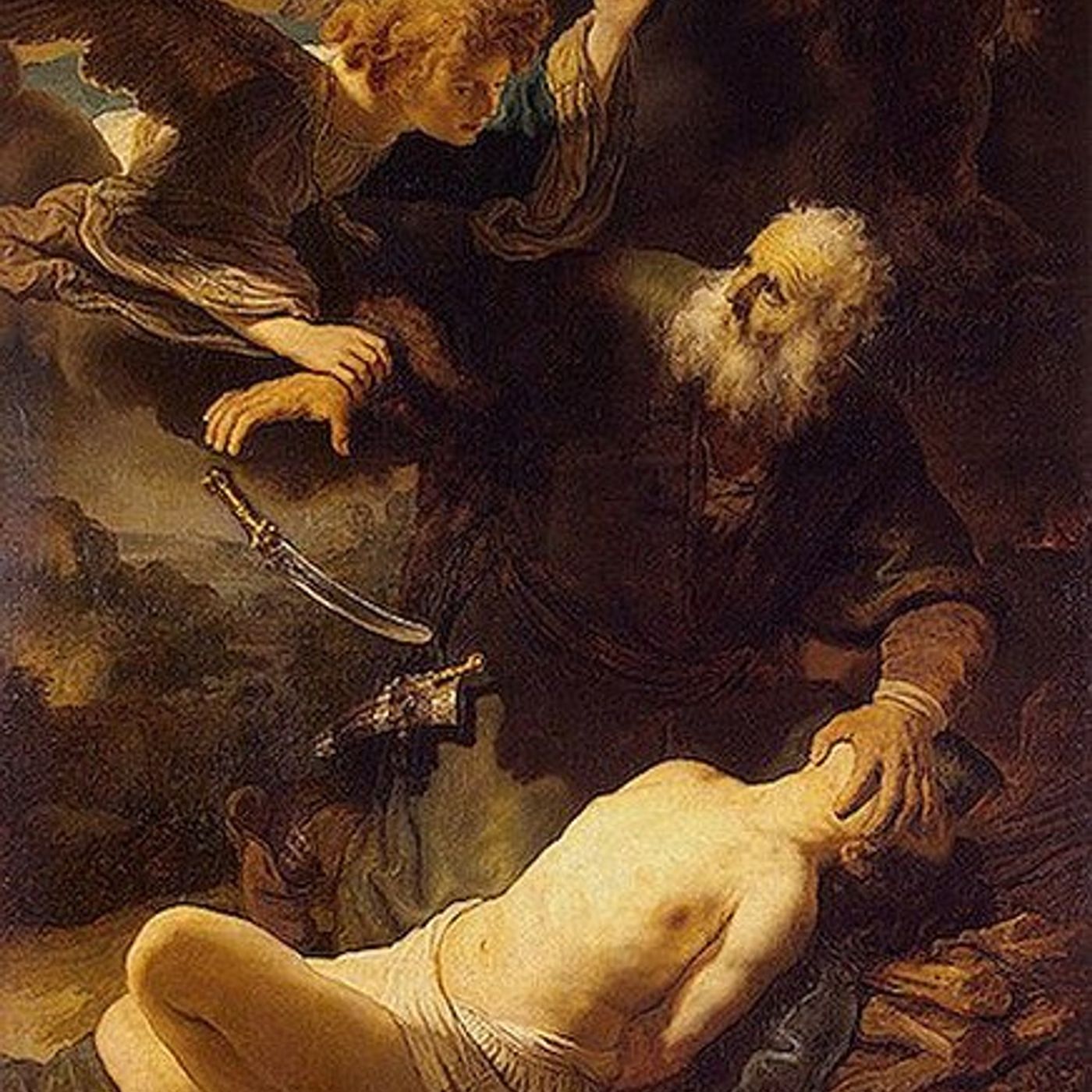
-Hello, I'm Jada Boomerad. -And I'm Robert Crowley. -This is Radio Lab, the podcast. -The podcast. -Now, one of the things that we do on this program, of course, is look at big ideas, trying to figure out how the world works. And to do that, we often talk to scientists who are, you know, asking questions, doing experiments, giving us data and statistics, but there are some questions that science just can't get to. -Well, this is holy week, so there's Easter being celebrated, and then we're going to have Passover. And so it seemed like an appropriate time to not ignore the fact that for most of the world, some of the deepest and most unknowable questions are examined through Bible stories. -That's right. And Robert, this is a sermon that you gave at a synagogue, right? -It's my attempt to try to reason, to try to make sense out of one of the darkest and most difficult stories that humans have ever told each other. The chapter in the Bible begins with a question. It's only one word long, one word. Abraham is at home with his family, his servants, his wife. We don't know what he's doing at this moment. The story doesn't say it's probably an ordinary day, a day in his life. And suddenly, Abraham hears a voice, and the voice says to him one word. Abraham and Abraham answers, "Here am I." This is not just a voice, this is the voice of God. The Bible says God, the creator of the universe, calling down to one man, calling to Abraham. Not for the first time, not at all. When Abraham was younger, God appeared to him and told him to leave his home, which Abraham did. And then God told Abraham to go to a strange land, which he did. And then God and Abraham exchanged promises and had a covenant together, and God told Abraham to send his first son, Ishmael, away into the desert, which Abraham did. And God told Abraham he had a plan to destroy the people of Sodom and Gomorrah, and this time, Abraham argued with God, and they went back and forth, Abraham and God. Can't we save those cities, or some people in those cities, or anyone in those cities, and later God sent angels to tell of the coming of Isaac? So it was not completely out of the ordinary. It wasn't a get-down on your knees miracle when God came to where Abraham was and asked, "Abraham?" And Abraham answered, "Here am I." It was just the start of another conversation, another in a series, until the next sentence. With God's next utterance, this conversation changes shape and becomes like no other conversation in the Bible, like no other story in the Bible, like no other story, because God says, "Take now thy son, thy only son whom thou love us, even Isaac, and get thee to the land of Moriah, and offer him there for a burnt offering upon one of the mountains which I shall tell thee of." Now, most of us know the circumstances here, the back story. We know that when Abraham was a young man living in Ur with his father and his brother, God came to him and told him that if he left Ur and traveled west away from his home, far from the places he knew, God would give him children, and from those children would come a mighty nation as numerous as the stars in the sky. And Abraham obeyed and traveled west and settled in a strange land, and he waited for his first child, the child that would spawn this
Transcription truncated.
Here at Radiolab we explore big ideas and ask big questions to see how the world works.