The Farmer’s Shotgun Trick That Cracked Tank Armor | War Audiobook
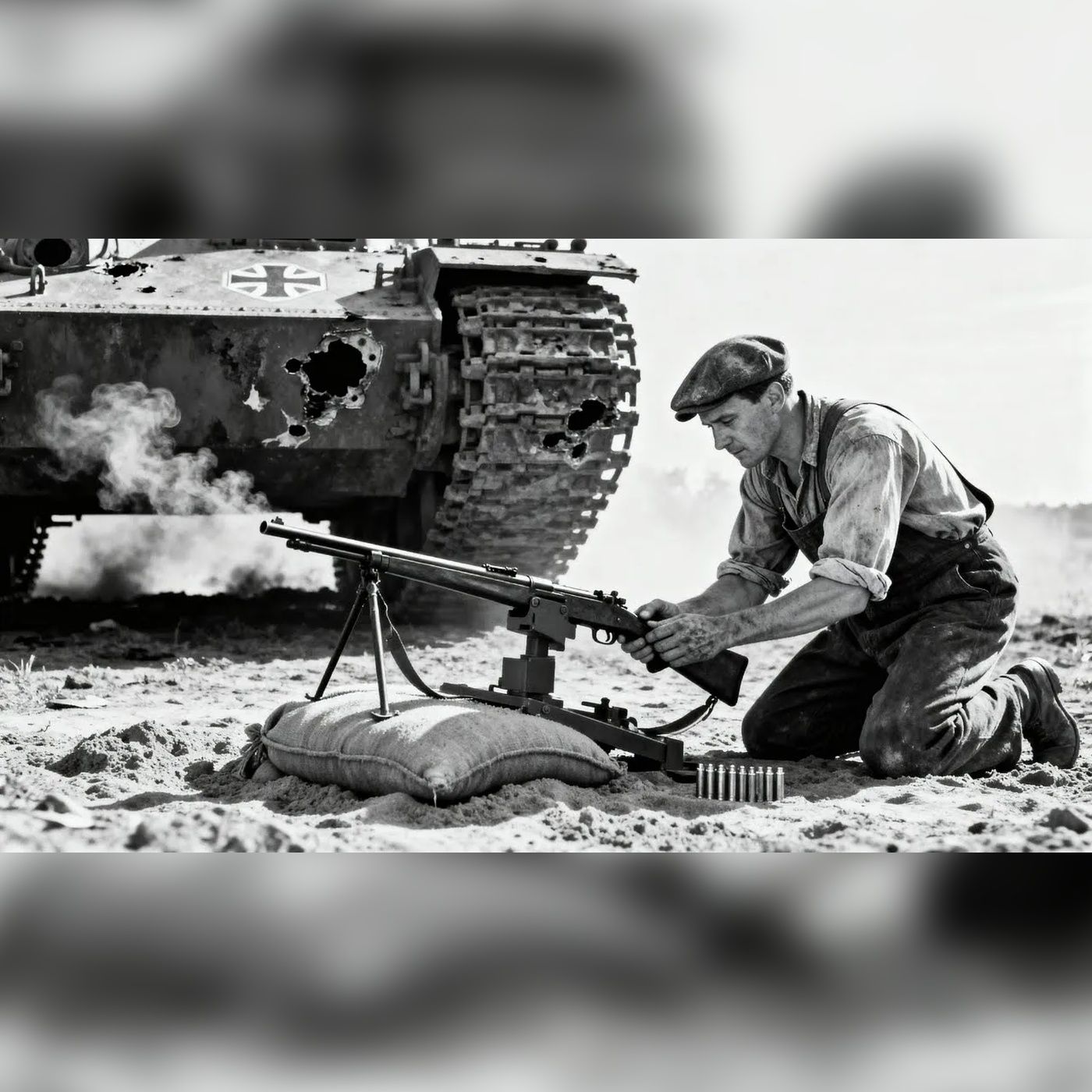
A farmer’s improvised shotgun method turns an ordinary weapon into a surprising threat against tank armor. This gripping military history story explores battlefield ingenuity, unconventional weapons, and the science behind an unlikely anti-tank tactic. Discover how one ridiculous idea challenged armored warfare. Listen now and share the story. #MilitaryHistory #WarHistory #TankWarfare #Audiobook
This episode includes AI-generated content.
- Duration
- 34m
- Broadcast on
- 20 Oct 2026
- Audio Format
- other
This episode appears to contain dynamically inserted ads. Transcript timestamps may be approximate.
November 8, 1942. Operation Torch beaches, North Africa. American GIs crouch behind sand dunes as German panzer fees thunder across the desert. They're 75 millimeter guns cutting through allied positions like wheat before a scythe. What they're witnessing represents the nightmare scenario that has haunted military planners since tanks first appeared on European battlefields. Private first-class Robert Watson levels his M1 rifle at the approaching panzer and knows with crystal clarity that his 3006 bullet will do absolutely nothing against three inches of hardened steel. Around him, his platoon faces the same horrible reality. They have no weapons capable of stopping enemy tanks. Zero. But what Private Watson doesn't know, what no American soldier on those beaches understands is that strapped to the back of his sergeant lies a device that will revolutionize anti-tank warfare forever. It weighs just 13 pounds, costs $43 to manufacture, and can punch through more armor than guns weighing 50 times as much. The weapon was invented by a man who had never seen a tank in combat, never attended military school, never even fired an artillery shell. His background was in farming techniques and industrial explosives, seemingly useless knowledge for the deadliest technical challenge of World War II. His name was Henry Mohout. Four years earlier, he had been mixing chemicals in a makeshift laboratory in Switzerland, trying to develop better blasting techniques for mining operations. What he discovered by accident would transform a Swiss farm boy into the man who gave individual soldiers the power to destroy the most advanced war machines ever built. The device on Sergeant Miller's back carries the designation M1A1 Bazuka, a name that will strike fear into German tank crews from Tunisia to Berlin. But the story of how a farmer's explosive experiments became America's most feared infantry weapon remains one of World War II's most extraordinary secrets, September 1, 1939. Germany invades Poland, and the world witnesses the birth of Blitzkrieg, lightning war. German Panzer divisions tear through Polish defenses in 18 days, proving that modern warfare belongs to whoever controls the most effective armored vehicles. Traditional anti-tank tactics developed during the static trench warfare of World War I collapse instantly against highly mobile armored formations. Allied military experts study the Polish catastrophe with growing alarm. British anti-tank doctrine relies on two pounder guns that fire solid shot. Chunks of hardened steel designed to punch through enemy armor through sheer kinetic energy. The physics are unforgiving. To penetrate thick armor, a projectile must weigh enormous amounts and travel at tremendous velocity. This requires massive guns, heavy ammunition, and perfect positioning. The mathematical reality devastates infantry formations. A two-pounder anti-tank gun weighs 1,000 order in 48 pounds and requires a truck to move. Once positioned, it cannot be repositioned quickly during battle. German tank tactics exploit this weakness ruthlessly. Panzer's advance rapidly, forcing anti-tank guns to engage at maximum range where accuracy plummets. Then close to point blank range where the guns cannot traverse fast enough to track moving targets. American observers reach even more disturbing conclusions. Colonel Leslie McNair, Chief Architect of U.S. Ground Forces Doctrine, analyzes pre-war exercises and delivers a sobering assessment. Our 37 millimeter anti-tank gun proves ineffective against modern armor at combat ranges. Frontal penetration of German tanks requires direct hits at distances under 400 yards. Ranges where enemy tanks can easily destroy the gun before it engages. The scientific community rallies to solve the anti-tank crisis. Dr. Charles Loretson at California Institute of Technology proposes electromagnetic railguns that could accelerate projectiles to unprecedented velocities. The technical challenges prove insurmountable. Railguns require enormous electrical power generators that make them completely impractical for battlefield use. The most promising approach appears to be increasing projectile velocity through longer gun barrels and more powerful propellant charges. German anti-tank guns demonstrate this philosophy. The feared 88 millimeter mere flat gun can penetrate any allied tank at ranges exceeding 2,000 yards. But physics demands a terrible price. The 88 millimeter weighs over 16,000 pounds and requires a powerful prime mover to position. Expert consensus emerges around an uncomfortable truth. Effective anti-tank weapons must be heavy, expensive, and tactically inflexible. Light weapons cannot generate sufficient kinetic energy to penetrate modern armor,
Transcription truncated.
A farmer’s improvised shotgun method turns an ordinary weapon into a surprising threat against tank armor. This gripping military history story explores battlefield ingenuity, unconventional weapons, and the science behind an unlikely anti-tank tactic. Discover how one ridiculous idea challenged armored warfare. Listen now and share the story. #MilitaryHistory #WarHistory #TankWarfare #Audiobook
This episode includes AI-generated content.