Another Negative Test, Blaming Your Past? You Don't Have to Find a Reason
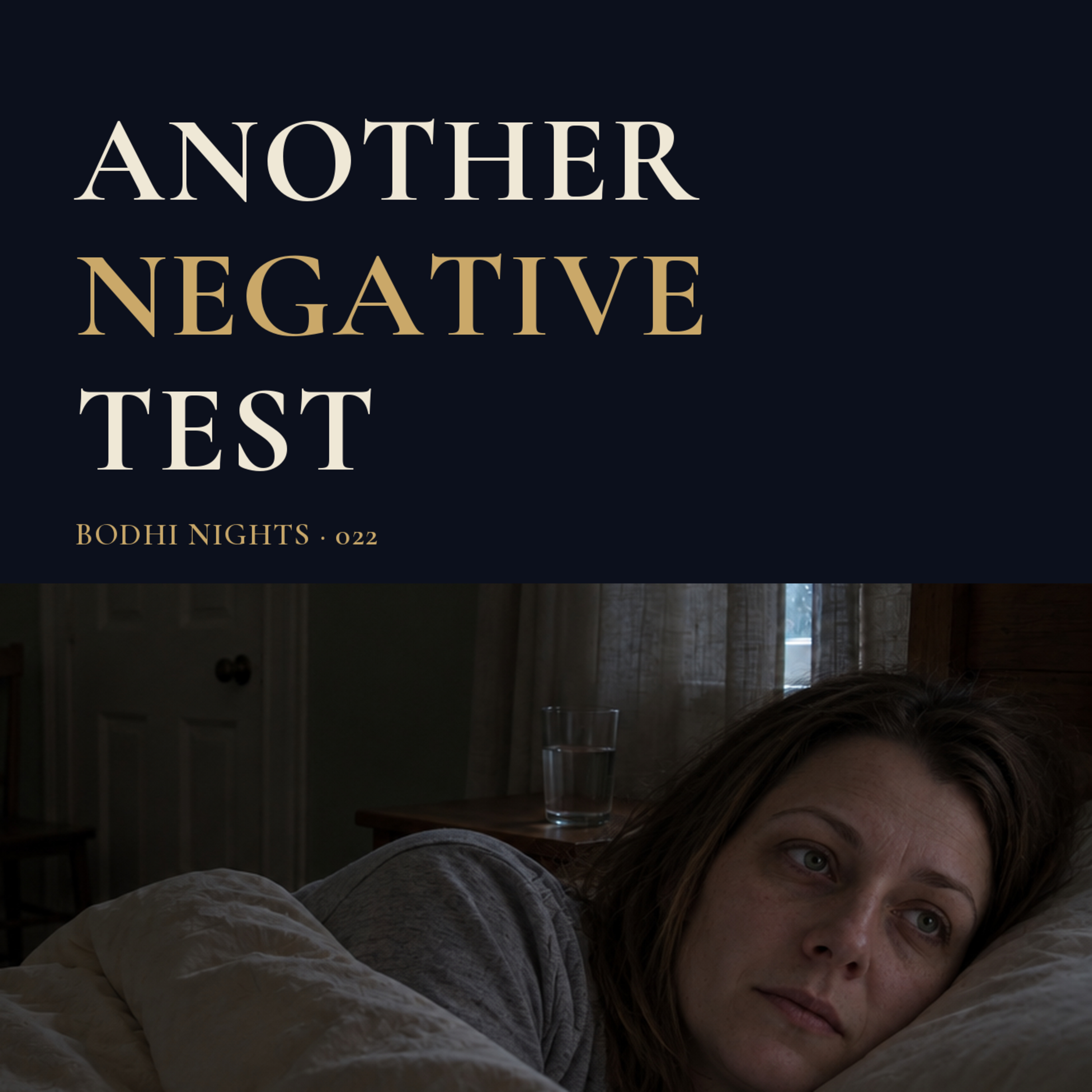
Another test has come back negative, and tonight you are going back through your whole life for the thing you must have done to deserve it. This story keeps you company with that tonight.
How to listen: keep the volume a little low. If you fall asleep partway through, that's fine; let it play. If you wake in the night, you can start again from anywhere.
It is ten to one on a Thursday night in November. Leah, who works behind the counter of a pharmacy in Derby, has just had her twenty-eighth negative test in two years and four months, and she has not told her husband Kieran yet. Now she is lying awake with her back to him, keeping a ledger in her head: the pill, the drinking in her twenties, a thing she once said on a sofa, the sandwiches eaten standing up. An old exchange about where feelings come from helps Leah see that her ledger was answering a question it was never written for. She does not have to find a reason tonight.
In the early texts, a wanderer tells the Buddha a view he has heard from other teachers: that everything a person feels, pleasant or painful, is because of past deeds. The Buddha answers with a list of where feelings come from: bile, phlegm, wind, their combination, a change in the weather, not taking care of oneself, something from outside (translators render this word as exertion, assault or harsh treatment), and, eighth, the result of past deeds. Those who say that everything comes from past deeds, he says, go beyond personal experience and beyond what is generally deemed true; they are wrong. In another talk he names four things that should not be thought about, because anyone who tries to think about them "will go mad or get frustrated"; one of them is the results of deeds. The narration keeps only "frustrated". A related talk (AN 3.61, background only) says that the view that everything is due to past deeds ends in inaction. The texts speak about feelings in general; they say nothing about why a body does or does not conceive, and neither does the story. Leah's reading of her own night is a fictional application.
The doctor's words in the story are bounded on purpose. A review of fourteen prospective studies of 3,583 women going through one cycle of assisted reproduction found that anxiety or depression before treatment did not differ between women who did and did not become pregnant; the authors note possible publication bias (Boivin, Griffiths and Venetis, BMJ 2011). The HFEA says there is no conclusive evidence that stress affects fertility treatment outcomes. These findings are about treatment; Leah is not in treatment, and the doctor says so. An earlier study (Domar and colleagues, 1993) found that women with infertility entering a support programme reported distress comparable to patients with cancer or high blood pressure, or in cardiac rehabilitation.
This is an original story for reflection and rest. It is not medical advice or treatment, it does not promise sleep, and it says nothing about whether anyone will conceive. The NHS suggests seeing a GP if you have not conceived after a year of trying. Clinics licensed by the HFEA must offer a chance to talk to a counsellor before treatment, and the HFEA lists support organisations. If low mood or worry stays with you for weeks, please talk to a doctor. Narrated with an AI-generated voice. The modern characters and events are fictional.
More stories: https://www.youtube.com/@bodhinights/videos
Podcast: https://open.spotify.com/show/7AlcURjtw8k1iqMrtpIo3N
Teaching references (Bhikkhu Sujato's translations):
https://suttacentral.net/sn36.21/en/sujato
https://suttacentral.net/an4.77/en/sujato
https://suttacentral.net/an3.61/en/sujato
Evidence and support:
https://doi.org/10.1136/bmj.d223
https://www.nhs.uk/conditions/infertility/
https://www.hfea.gov.uk/
#BodhiNights #SleepStory #Infertility
The episode artwork is AI-generated.
- Duration
- 57m
- Broadcast on
- 27 Oct 2026
Another test has come back negative, and tonight you are going back through your whole life for the thing you must have done to deserve it. This story keeps you company with that tonight.
How to listen: keep the volume a little low. If you fall asleep partway through, that's fine; let it play. If you wake in the night, you can start again from anywhere.
It is ten to one on a Thursday night in November. Leah, who works behind the counter of a pharmacy in Derby, has just had her twenty-eighth negative test in two years and four months, and she has not told her husband Kieran yet. Now she is lying awake with her back to him, keeping a ledger in her head: the pill, the drinking in her twenties, a thing she once said on a sofa, the sandwiches eaten standing up. An old exchange about where feelings come from helps Leah see that her ledger was answering a question it was never written for. She does not have to find a reason tonight.
In the early texts, a wanderer tells the Buddha a view he has heard from other teachers: that everything a person feels, pleasant or painful, is because of past deeds. The Buddha answers with a list of where feelings come from: bile, phlegm, wind, their combination, a change in the weather, not taking care of oneself, something from outside (translators render this word as exertion, assault or harsh treatment), and, eighth, the result of past deeds. Those who say that everything comes from past deeds, he says, go beyond personal experience and beyond what is generally deemed true; they are wrong. In another talk he names four things that should not be thought about, because anyone who tries to think about them "will go mad or get frustrated"; one of them is the results of deeds. The narration keeps only "frustrated". A related talk (AN 3.61, background only) says that the view that everything is due to past deeds ends in inaction. The texts speak about feelings in general; they say nothing about why a body does or does not conceive, and neither does the story. Leah's reading of her own night is a fictional application.
The doctor's words in the story are bounded on purpose. A review of fourteen prospective studies of 3,583 women going through one cycle of assisted reproduction found that anxiety or depression before treatment did not differ between women who did and did not become pregnant; the authors note possible publication bias (Boivin, Griffiths and Venetis, BMJ 2011). The HFEA says there is no conclusive evidence that stress affects fertility treatment outcomes. These findings are about treatment; Leah is not in treatment, and the doctor says so. An earlier study (Domar and colleagues, 1993) found that women with infertility entering a support programme reported distress comparable to patients with cancer or high blood pressure, or in cardiac rehabilitation.
This is an original story for reflection and rest. It is not medical advice or treatment, it does not promise sleep, and it says nothing about whether anyone will conceive. The NHS suggests seeing a GP if you have not conceived after a year of trying. Clinics licensed by the HFEA must offer a chance to talk to a counsellor before treatment, and the HFEA lists support organisations. If low mood or worry stays with you for weeks, please talk to a doctor. Narrated with an AI-generated voice. The modern characters and events are fictional.
More stories: https://www.youtube.com/@bodhinights/videos
Podcast: https://open.spotify.com/show/7AlcURjtw8k1iqMrtpIo3N
Teaching references (Bhikkhu Sujato's translations):
https://suttacentral.net/sn36.21/en/sujato
https://suttacentral.net/an4.77/en/sujato
https://suttacentral.net/an3.61/en/sujato
Evidence and support:
https://doi.org/10.1136/bmj.d223
https://www.nhs.uk/conditions/infertility/
https://www.hfea.gov.uk/
#BodhiNights #SleepStory #Infertility
The episode artwork is AI-generated.